
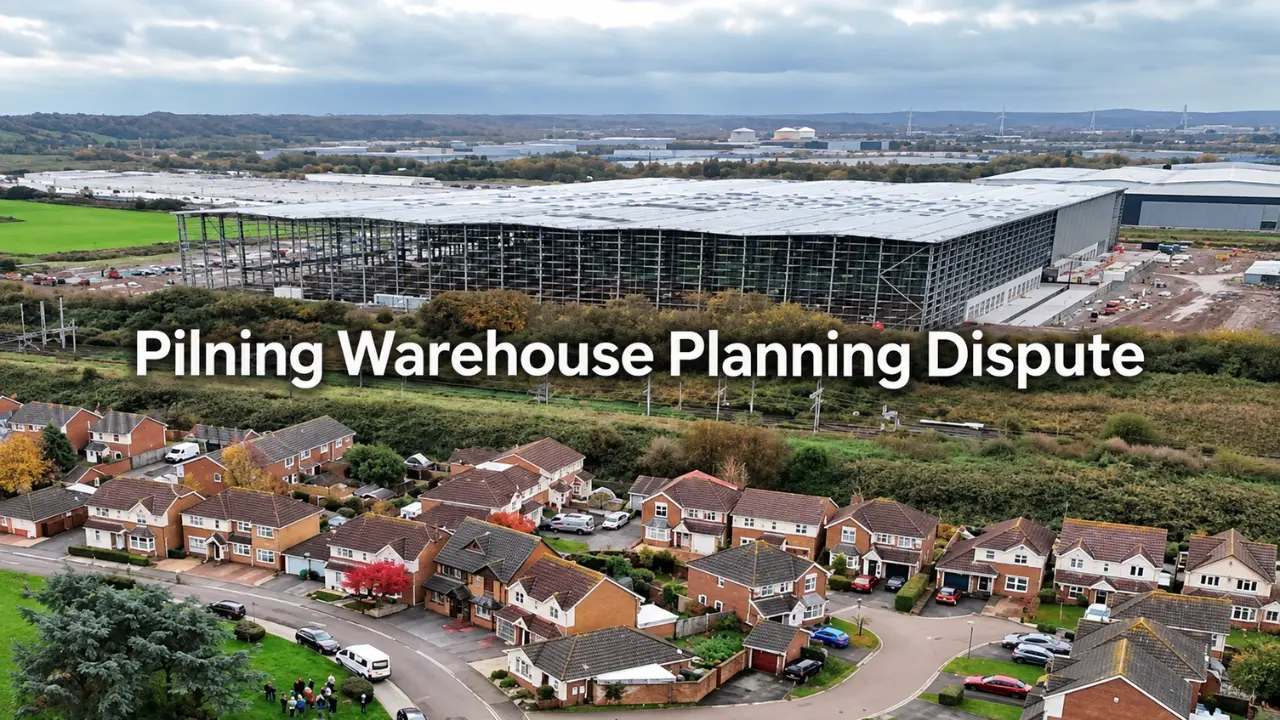
The enormous warehouse development near Pilning has raised a serious question about how much control local communities have over the places where they live. Residents are facing an industrial building that they believe is too large and too close to their homes, while the planning history behind the project has made it difficult for local authorities to respond in the way campaigners want. The pilning warehouse planning dispute is no longer just about one building. It has become a wider argument about historic planning permissions, residential protection and whether decisions made decades ago should still shape modern communities.
The controversy has attracted attention from residents, local councillors, South Gloucestershire Council and Claire Young, the MP for Thornbury and Yate. The use of historic planning permissions dating back to 1957 and 1958 has become one of the most important parts of the disagreement. With further parliamentary discussions taking place in 2026, the situation has developed into a significant local planning issue.
What Happened in the Pilning Warehouse Planning Dispute?
Pilning is a village in South Gloucestershire, close to Severn Beach and the wider Severnside industrial area. Its location has made the surrounding land attractive for industrial and commercial development. However, the construction of a very large warehouse close to residential properties has created considerable opposition.
The building has become locally known as the MegaShed because of its enormous dimensions. Reports describe a warehouse exceeding 500,000 square feet and standing more than 20 metres high. Its scale has become a central concern for people living in the surrounding area, particularly those near Cranmoor Green.
The pilning warehouse planning dispute developed because residents questioned how such a substantial industrial structure could proceed under planning arrangements established decades earlier. They argued that the development should receive closer scrutiny under modern planning expectations.
For nearby households, the issue is not an abstract disagreement about development policy. It concerns the immediate surroundings of their homes, including the appearance of the building, potential disturbance and the future character of their neighbourhood.
The controversy also raises a difficult question for planning authorities: should an old planning permission remain powerful enough to influence major development when the surrounding community has changed so significantly?
What Is the Pilning MegaShed?
The MegaShed is a large industrial warehouse associated with the Severnside development area. Its size distinguishes it from ordinary commercial buildings and explains why it has attracted attention beyond the immediate village.
Reports place its floor area above 500,000 square feet, with a height exceeding 20 metres. The building’s proximity to residential properties has made its physical presence particularly controversial.
Some nearby homes have been reported to sit approximately 150 metres from the warehouse. That distance has become relevant to discussions about the effect of a large industrial structure on the surrounding residential environment.
A warehouse of this scale can change the appearance of a neighbourhood even when it does not directly occupy residential land. Its walls, lighting, service areas and vehicle movements can affect how nearby residents experience their surroundings.
The pilning warehouse planning dispute has therefore attracted attention for two connected reasons: the size of the building and the planning arrangements that allowed the development to proceed.
It is also necessary to distinguish between the building itself and the wider industrial area. Severnside has a longer history of industrial planning, and the MegaShed is part of a much larger development landscape.
Why the Historic 1957 Planning Permission Matters
The most complicated part of the pilning warehouse planning dispute concerns historic planning permissions.
The development is connected to planning consent granted in 1957 for industrial development in the Severnside area. A further historic permission from 1958 has also featured in discussions about the wider planning position.
These permissions were established under planning circumstances very different from those that exist today. Residential expectations, environmental standards, transport planning and public consultation have all changed considerably since the middle of the twentieth century.
Campaigners argue that permissions granted so long ago should not automatically determine what can happen to nearby communities today.
Their concern is that historic consent can provide a route for development without the same level of modern scrutiny that a new planning application might receive.
This does not mean that every aspect of an old permission is automatically unlimited or that developers can ignore all current legal requirements. The precise rights depend on the wording, scope and legal status of the relevant consent.
However, the existence of historic permissions creates a difficult position for local authorities. If a development is legally authorised under an existing consent, the council may have limited opportunities to impose additional planning conditions.
That is why the pilning warehouse planning dispute has developed into a debate about the wider planning system rather than remaining a straightforward disagreement over one construction project.
Why Pilning Residents Are Opposing the Warehouse
Residents have raised concerns about the effect of the warehouse on their everyday lives. The most significant objections relate to the building’s size, potential noise, privacy, daylight and the industrial activity associated with large-scale warehousing.
The concerns deserve attention because residential areas and industrial developments do not always sit comfortably alongside one another.
The effect on nearby homes
A building exceeding 20 metres in height can create a substantial visual presence, especially when residential properties are relatively close.
Residents have questioned whether the scale and position of the warehouse are appropriate for the surrounding area. The concern is not simply that an industrial building exists, but that its dimensions may change the character of nearby residential surroundings.
Noise from industrial operations
Warehouse operations can involve delivery vehicles, loading equipment, reversing alarms, machinery and regular vehicle movements.
Residents have raised concerns about noise associated with industrial activity. The actual impact depends on operating hours, site management, vehicle routes and the effectiveness of noise controls.
A distinction must be made between reported concerns and independently established breaches of noise regulations. Nevertheless, residents should have a clear route to report and investigate persistent disturbance.
Loss of privacy and daylight
The warehouse’s size and proximity have also prompted concerns about residential privacy and natural light.
Large industrial buildings can affect the outlook from nearby properties. Depending on their position and surrounding structures, they can also influence the amount of daylight reaching neighbouring homes.
These concerns are particularly relevant where houses were established in an area before the present scale of industrial development became a major issue.
Traffic, Flooding and Environmental Concerns
The pilning warehouse planning dispute also involves questions about the wider environmental and infrastructure effects of industrial development.
Large warehouses can generate substantial vehicle movements. Delivery schedules, heavy goods vehicles and staff journeys may place additional pressure on local roads.
For residents, the concern is whether existing infrastructure can accommodate the traffic associated with a major industrial site without creating additional problems for the surrounding community.
Flooding is another issue raised by campaigners. Large buildings and associated paved areas can change how rainwater moves across land. When natural surfaces are replaced with roofs, concrete and hardstanding, drainage arrangements become particularly important.
However, it would be misleading to claim that the warehouse has caused flooding without supporting technical evidence. A proper assessment would need to consider drainage design, surface water management, ground conditions and the wider catchment area.
Dust from construction and industrial activity has also featured in residents’ concerns.
These environmental questions matter because the consequences of development do not stop at the boundary of a warehouse site. Roads, drainage networks and neighbouring properties can all be affected by decisions made about industrial land.
Claire Young’s Involvement in the Pilning Warehouse Planning Dispute
The controversy has received parliamentary attention through Claire Young, the MP for Thornbury and Yate.
Her involvement has helped bring the concerns of local residents into the national political discussion. Rather than treating the issue as a disagreement limited to one village, the parliamentary discussion has highlighted the difficulties created by historic planning permissions.
On 11 December 2025, Claire Young raised the issue in Parliament, discussing the effects of historic planning consents and the concerns of people living near the warehouse development.
A further development occurred on 18 June 2026, when she presented a parliamentary petition concerning warehouse development in Pilning.
The petition had attracted more than 3,500 online signatures, reflecting the level of public interest in the issue.
The petition called for government action to encourage planning authorities to revoke or amend the historic consent so that appropriate conditions and restrictions could better protect local communities.
The pilning warehouse planning dispute consequently gained a wider political dimension. Residents were no longer relying only on local objections; they were also seeking changes to the planning arrangements that govern development in the area.
Parliamentary involvement does not automatically cancel planning permissions or require a developer to stop work. Its significance lies in bringing the legal and political questions to the attention of government ministers.
South Gloucestershire Council’s Response
South Gloucestershire Council has also taken steps to address the concerns surrounding historic planning permissions.
On 20 May 2026, councillors approved a cross-party motion concerning the old planning arrangements.
The motion reflected concerns about the ability of historic permissions to influence major development without the same safeguards and conditions expected under modern planning practices.
On 2 July 2026, the council announced that leaders from its three political groups had written to the Secretary of State for Housing, Communities and Local Government.
Their request focused on the historic 1957 and 1958 permissions and the possibility of amending or repealing them through government action.
The council also raised concerns about modern infrastructure contributions and meaningful community involvement.
This response is significant because it shows that dissatisfaction with the current planning arrangements extends beyond individual residents.
However, requesting government intervention is not the same as securing a legal change. The council still faces the practical and legal difficulties associated with altering established planning permissions.
The pilning warehouse planning dispute therefore remains dependent on what powers are available, how those powers can be exercised and whether government ministers are prepared to consider changes to the existing arrangements.
What Did the Government Say in October 2026?
A particularly important development came on 13 October 2026, when the Government responded to the parliamentary petition.
The response explained that local planning authorities have legal powers to revoke or modify planning permissions before development has been completed.
This is important because it confirms that historic permissions are not necessarily beyond any form of legal intervention.
However, exercising those powers can create financial consequences.
The Government explained that authorities may become liable to pay compensation when revoking or modifying planning permission. Compensation can include expenditure already incurred and other losses or damage sustained as a result of the decision.
This creates a difficult calculation for councils.
Even where local representatives believe that an old permission should be changed, the financial consequences may make intervention complicated. Authorities must consider the potential costs alongside the benefits of changing the planning arrangements.
Housing and Planning Minister Matthew Pennycook also explained that ministers could not comment on specific planning applications because of their quasi-judicial responsibilities.
The response did not announce that the historic permissions had been cancelled. Nor did it order the warehouse to close.
Instead, it clarified the legal framework and the potential compensation issues surrounding intervention.
For people following the pilning warehouse planning dispute, this parliamentary response is one of the most useful developments because it explains why political support alone may not be enough to change the situation.
Could the Historic Planning Permission Be Changed?
The Government’s October response makes clear that local planning authorities have powers to revoke or modify planning permissions before development is completed.
However, having a legal power and using it successfully are two different things.
The compensation question is likely to be a major consideration for South Gloucestershire Council. If revocation or modification creates a financial liability, the authority must understand the potential cost before deciding whether to proceed.
The precise position would depend on the relevant permission, the development already carried out, expenditure incurred and the legal circumstances of any proposed intervention.
There is also a practical question about what changes would actually achieve.
If the objective is to protect residents from noise, traffic or other effects, the council would need to consider which restrictions could legally be introduced and whether they would address the problems campaigners have identified.
The pilning warehouse planning dispute demonstrates the difficulty of reconciling established development rights with changing community expectations.
It also highlights why old planning permissions deserve careful examination when the surrounding area has experienced significant residential and industrial growth.
Further Warehouse Development Around Pilning and Severn Beach
The existing MegaShed is not the only subject of concern in the wider area.
Pilning and Severn Beach Parish Council has also raised objections to proposals involving additional warehouse development.
In June 2026, the Parish Council reported concerns about proposed warehouse allocations on Green Belt land between Marsh Common Road and the railway.
It also discussed proposed allocations at Plots M and N on Severn Road, an area known as Orchard Pools.
The Parish Council questioned whether sufficient evidence existed to justify allocating additional land for warehouse development.
These proposals form part of the wider South Gloucestershire Local Plan process and should not be confused with the existing MegaShed development.
That distinction matters. An existing building operating under historic planning arrangements and a proposed future land allocation are not the same planning situation.
Future proposals may face a different assessment process, depending on their planning status and the applicable policies.
The wider debate raises an important question for Pilning and Severn Beach: how much additional industrial development can the area accommodate without placing unreasonable pressure on residential communities and local infrastructure?
What Happens Next in the Pilning Warehouse Planning Dispute?
The next stage will depend on decisions made by the council, the Government and the relevant planning authorities.
The first issue is whether the Government considers changing the legal position surrounding the historic permissions. The council’s request for intervention has made this a central part of the discussion.
Another issue is whether South Gloucestershire Council pursues the available legal options to revoke or modify existing permissions. Any such decision would need to account for the potential compensation liability explained in the October 2026 parliamentary response.
Future warehouse proposals will also require attention. The discussions surrounding Green Belt land and Orchard Pools could influence the direction of industrial development across the wider Severnside area.
Residents are likely to continue pressing for greater involvement in planning decisions, clearer information and stronger protection against industrial disturbance.
The pilning warehouse planning dispute may therefore have consequences beyond the current building. Its outcome could influence how local authorities approach older industrial permissions and how communities respond to large developments near residential properties.
Conclusion: Pilning Needs More Than Promises of Planning Reform
The pilning warehouse planning dispute exposes a serious weakness in the relationship between historic planning decisions and modern residential expectations. A permission granted decades ago can still shape the lives of people who had no opportunity to influence the original decision.
The MegaShed has become the centre of that disagreement, but the deeper issue concerns how much influence residents should have over major development in their neighbourhood.
South Gloucestershire Council and local campaigners have raised legitimate questions about the old permissions. Claire Young’s parliamentary involvement has brought those concerns to Westminster, while the Government’s October 2026 response has clarified the legal obstacles to intervention.
What matters now is whether those discussions lead to practical action. Residents need clear decisions, not another round of statements that leave the underlying problems unresolved.
A planning system should not treat a community’s concerns as irrelevant simply because an industrial permission was granted in 1957. Historic rights deserve legal consideration, but so do the people who have to live alongside the consequences.
Frequently Asked Questions
1. Where is the Pilning MegaShed located?
The MegaShed is located in the Pilning area of South Gloucestershire, near Cranmoor Green and the wider Severnside industrial area. Its proximity to residential properties has been a major source of local opposition.
2. How large is the warehouse involved in the dispute?
Published reports describe the warehouse as exceeding 500,000 square feet, with a height of more than 20 metres. These dimensions have contributed to concerns about its visual impact and relationship with nearby homes.
3. Why are residents concerned about the 1957 planning permission?
Residents believe that the historic consent does not reflect modern expectations for environmental protection, residential amenity and community involvement. They want the planning arrangements reconsidered so that appropriate modern safeguards can apply.
4. Can South Gloucestershire Council legally cancel the historic planning permission?
Local planning authorities have powers to revoke or modify planning permissions before development is completed. However, the Government has explained that exercising these powers can result in compensation liabilities, making the decision legally and financially complicated.
5. Has the Government ordered the Pilning warehouse to close?
No. The Government’s parliamentary response on 13 October 2026 explained the legal powers available to planning authorities and the potential compensation consequences. It did not announce the cancellation of the historic permissions or order the existing warehouse to close.