
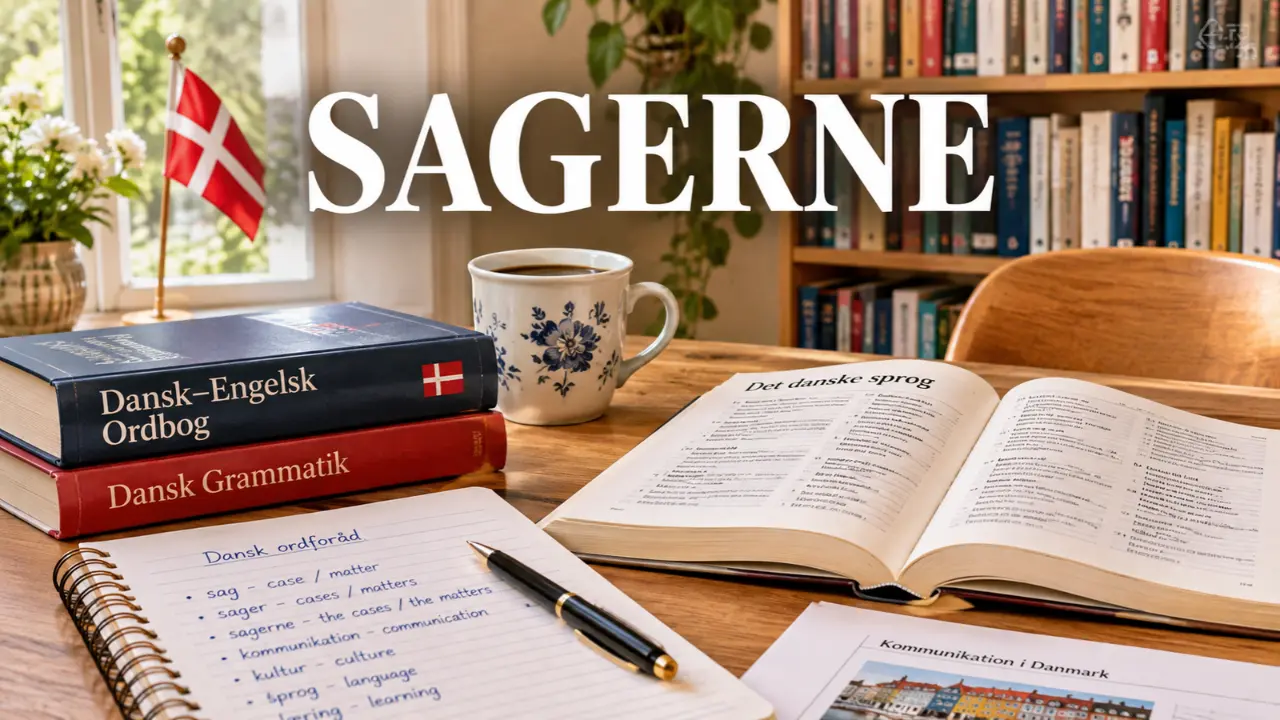
Language becomes interesting when a single expression can carry different meanings depending on the situation. Danish is a good example of this, particularly in conversations involving personal matters, workplace responsibilities, public discussions, and legal situations. Sagerne deserves attention because it appears in these different settings and connects ordinary communication with the way people organize, discuss, and understand real-life issues.
Understanding its place in Danish communication requires more than looking at an English translation. The surrounding sentence, the people involved, and the subject being discussed all influence how the expression should be understood. From everyday conversations to official documents, sagerne provides an interesting look at how language communicates information with precision.
The Danish Language Background Behind Sagerne
Danish has a grammatical structure that allows nouns to change according to number and definiteness. This is particularly noticeable when discussing individual matters and groups of related matters.
The foundation of sagerne is the Danish noun sag. Depending on the situation, sag can describe a case, matter, issue, or affair. When discussing more than one matter, the plural form sager is used. Adding the definite ending produces sagerne.
This distinction is important because Danish speakers use these forms to communicate whether they are discussing something general or particular.
For example, a person might discuss a matter that needs attention at work. When that discussion expands to include several known issues, the language changes accordingly. The distinction makes communication clearer without requiring additional descriptive words.
Danish grammar also uses definite endings differently from English. English often places the word “the” before a noun, while Danish frequently attaches the definite marker to the end of the noun.
This grammatical feature explains why sagerne has a recognizable structure within ordinary Danish sentences.
How Sagerne Appears in Everyday Conversations
Everyday communication provides one of the clearest ways to understand the practical role of sagerne. People regularly discuss responsibilities, personal concerns, unresolved questions, and situations that require decisions.
Imagine a conversation between two colleagues discussing several unfinished assignments. They might refer to the matters that still need attention before a project can move forward. In this setting, the expression fits naturally into a discussion about responsibilities and outstanding issues.
A similar situation can occur between family members. They may discuss arrangements, personal concerns, or decisions involving different members of the household. The surrounding conversation helps establish exactly which matters are being discussed.
This flexibility makes sagerne useful in ordinary communication. It does not restrict a conversation to one particular subject.
The most important point is context. A discussion about workplace responsibilities is different from a conversation about family arrangements, even when the same grammatical form appears.
For anyone learning Danish, paying attention to the complete sentence is far more useful than memorizing an isolated translation.
The Difference Between Sag, Sager, and Sagerne
Understanding the relationship between these three forms makes Danish sentences easier to interpret.
The word sag is the singular indefinite form. It can describe one case, matter, or issue without necessarily identifying a particular one.
Sager is the plural indefinite form. It is used when discussing multiple matters without presenting them as a specific, previously identified group.
Sagerne is the definite plural form. It describes particular matters that are already known, established, or identifiable from the conversation.
Consider a practical workplace example.
A manager first mentions a sag that requires attention. Later, the manager refers to several sager that need to be reviewed. Once the group of matters has been established, the manager can discuss sagerne when referring to those particular issues.
The progression shows how small grammatical changes can influence the meaning of a sentence.
| Danish form | Grammatical use | English equivalent |
|---|---|---|
| Sag | Singular indefinite | A case or matter |
| Sager | Plural indefinite | Cases or matters |
| Sagerne | Plural definite | The cases or matters |
This distinction is worth learning because confusing these forms can make otherwise understandable Danish sentences sound incorrect.
Why Context Matters When Interpreting Sagerne
Direct translation is useful, but it does not always communicate the intended meaning accurately.
The English words “cases,” “matters,” and “issues” overlap, yet they are not interchangeable in every situation. Choosing the right translation requires understanding what the speaker is discussing.
For example, in a legal conversation, cases may be the most appropriate translation. In an office discussion, matters or issues might communicate the intended meaning more naturally. In an administrative setting, affairs or cases could be suitable depending on the document.
Consider three situations:
- Legal discussion: A group of court-related cases is being reviewed.
- Workplace communication: Employees are discussing outstanding matters that require decisions.
- Administrative communication: Officials are handling particular files or matters involving public services.
Each situation creates a different interpretation, even though the same Danish grammatical form can appear.
This is why translators should avoid selecting an English equivalent before reading the entire sentence. A translation that sounds correct in isolation can become misleading when placed in the wrong context.
For Danish learners, this is also a useful reminder that vocabulary and sentence comprehension should develop together.
The Role of Sagerne in Workplace and Professional Communication
Professional communication depends on clarity. Employees, managers, administrators, and business owners need to discuss responsibilities without creating unnecessary confusion.
Danish workplace conversations frequently involve practical subjects such as project progress, pending decisions, customer concerns, internal responsibilities, and documentation.
In these situations, sagerne can appear when participants refer to particular matters that require attention.
Imagine a department meeting where employees review unresolved customer requests. The team might discuss which matters have been completed, which require additional information, and which need managerial approval.
The ability to distinguish between general matters and specific matters helps participants follow the discussion.
Written communication requires the same care. In emails, reports, and internal notes, the correct grammatical form can make a difference to how clearly information is presented.
A professional who is learning Danish should therefore pay attention to noun endings rather than relying entirely on vocabulary memorization.
The practical benefit is straightforward: better grammar supports clearer instructions, more accurate reports, and fewer misunderstandings between colleagues.
Legal and Administrative Uses in Danish Society
Legal and administrative communication is another setting where the meaning of individual words depends heavily on context.
A legal case involves a specific set of circumstances, documents, arguments, and decisions. Administrative matters may involve applications, public services, official records, or responsibilities handled by government departments.
When several particular matters are being discussed, sagerne can fit naturally into this type of communication.
For example, an administrative employee might need to review previously submitted applications. A legal professional might discuss a group of ongoing cases. In both situations, the people involved understand which matters are being referenced through the surrounding discussion.
However, the expression should not automatically be translated as legal cases every time it appears in an official document.
That would be an unnecessary limitation.
A government document can discuss administrative matters without referring to court proceedings. Similarly, a business report might mention cases that have nothing to do with the legal system.
Readers should identify the subject first and choose the translation second. This approach produces more reliable interpretations and avoids confusing everyday administrative language with specialized legal terminology.
Understanding Sagerne Through Danish News and Journalism
News reporting frequently deals with situations involving public decisions, investigations, social concerns, legal proceedings, and government responsibilities.
These subjects often involve multiple connected matters. Journalists need language that allows them to discuss those matters without repeating lengthy descriptions in every sentence.
This creates a natural setting for sagerne.
For example, a news report might cover a collection of administrative complaints or discuss several previously introduced cases. Once the subject has been established, the definite plural form can help maintain continuity throughout the report.
Readers should still pay attention to the subject of the article. A report about a court proceeding requires a different interpretation from an article discussing political affairs or public administration.
This is particularly important for international readers who rely on translated headlines or automatically generated translations.
A single translated word may not capture the full meaning of the original Danish sentence. Reading the surrounding paragraphs can provide the missing information.
Sagerne and Modern Digital Communication
Digital communication has made it easier for people to encounter languages they do not speak. Search engines, online newspapers, discussion forums, educational platforms, and translation applications regularly expose readers to unfamiliar vocabulary.
Danish expressions can appear in international search results when users investigate a document, read a news story, or come across a Danish website.
In this environment, sagerne may attract attention from readers who want to understand the context of a sentence or identify the subject of a discussion.
Translation applications can provide a useful starting point, but they should not be treated as a replacement for grammatical understanding.
Automatic translation systems sometimes struggle with definite forms, sentence structure, and expressions that have several possible translations.
For example, translating sagerne without considering the surrounding sentence may produce a result that sounds unnatural in English. A translation based on the complete passage is more likely to preserve the original intention.
Online readers should also distinguish between linguistic usage and digital branding. A website, business, or social media account could independently adopt a Danish expression as its name. That does not automatically change its established grammatical meaning.
The distinction matters because search results can mix language explanations with unrelated websites and commercial references.
Common Mistakes When Learning Danish Vocabulary
Danish vocabulary becomes easier to understand when learners recognize patterns rather than memorizing individual words without context.
One common mistake is treating sag, sager, and sagerne as interchangeable. Although they share the same foundation, their grammatical functions differ.
Another mistake is assuming that every occurrence of sagerne must describe a legal matter. The word can appear in professional, personal, administrative, and public discussions.
Literal translation is another problem. A dictionary may provide several English equivalents, but the most suitable choice depends on the sentence.
Learners should also avoid ignoring definite and indefinite forms. Danish uses these grammatical distinctions to communicate information that English expresses differently.
A practical learning method is to collect complete sentences rather than individual vocabulary entries. Reading examples from newspapers, everyday conversations, and educational materials helps learners understand how nouns function naturally.
Writing short sentences is equally useful. By practicing sag, sager, and sagerne in different situations, learners can develop a better sense of when each form is appropriate.
Practical Ways to Improve Your Understanding of Danish
Learning a language requires regular exposure and active practice. Memorizing translations can help initially, but real progress comes from understanding how words work in complete sentences.
Start by reading short Danish passages. News articles, public information pages, and beginner-level reading materials provide useful examples of everyday grammar.
Next, compare the original Danish text with a reliable English translation. Notice how the translator chooses between words such as cases, matters, and issues.
Writing exercises can also help. Create short examples involving workplace discussions, personal arrangements, and administrative situations. Practice using sag, sager, and sagerne according to the grammatical requirements.
Listening is another valuable exercise. Danish podcasts, interviews, and recorded conversations expose learners to natural sentence patterns that may not be obvious in written examples.
Finally, review mistakes instead of simply memorizing corrected sentences. Understanding why a particular noun form was selected will make it easier to recognize the same pattern in future conversations.
Conclusion: Grammar Makes the Difference in Real Communication
Understanding Danish requires attention to the details that connect words with their surrounding sentences. Sagerne demonstrates why grammatical endings matter and why direct translation should never replace context.
Whether it appears in a workplace conversation, an administrative document, a legal discussion, or a news report, its intended interpretation depends on the subject being discussed.
For Danish learners, the most useful lesson is to understand the relationship between sag, sager, and sagerne rather than memorize three separate translations. Once that distinction becomes familiar, reading and interpreting Danish becomes considerably more straightforward.
Good language skills are not built by collecting isolated words. They develop when people learn to recognize how those words function in real communication.
Frequently Asked Questions
1. Can sagerne be used when discussing personal problems?
Yes. It can appear in conversations about particular personal matters or issues, provided the grammatical context is appropriate. The surrounding sentence determines the most natural English translation.
2. Why does Danish place definite endings at the end of nouns?
Danish commonly expresses definiteness through noun endings rather than always placing a separate word equivalent to “the” before the noun. This is an important feature of Danish grammar.
3. Is sagerne appropriate in formal business writing?
Yes. It can appear in professional discussions, reports, and written communication when referring to particular matters or cases. Correct sentence structure remains important.
4. Can automatic translation tools translate sagerne accurately?
They can provide useful translations, but results may vary according to sentence structure and context. Reviewing the complete passage is more reliable than translating the word separately.
5. What is the easiest way to remember the difference between sag, sager, and sagerne?
Remember their grammatical progression: sag is singular indefinite, sager is plural indefinite, and sagerne is plural definite. Practicing all three forms in complete sentences is the most effective way to recognize their differences.