
Introduction
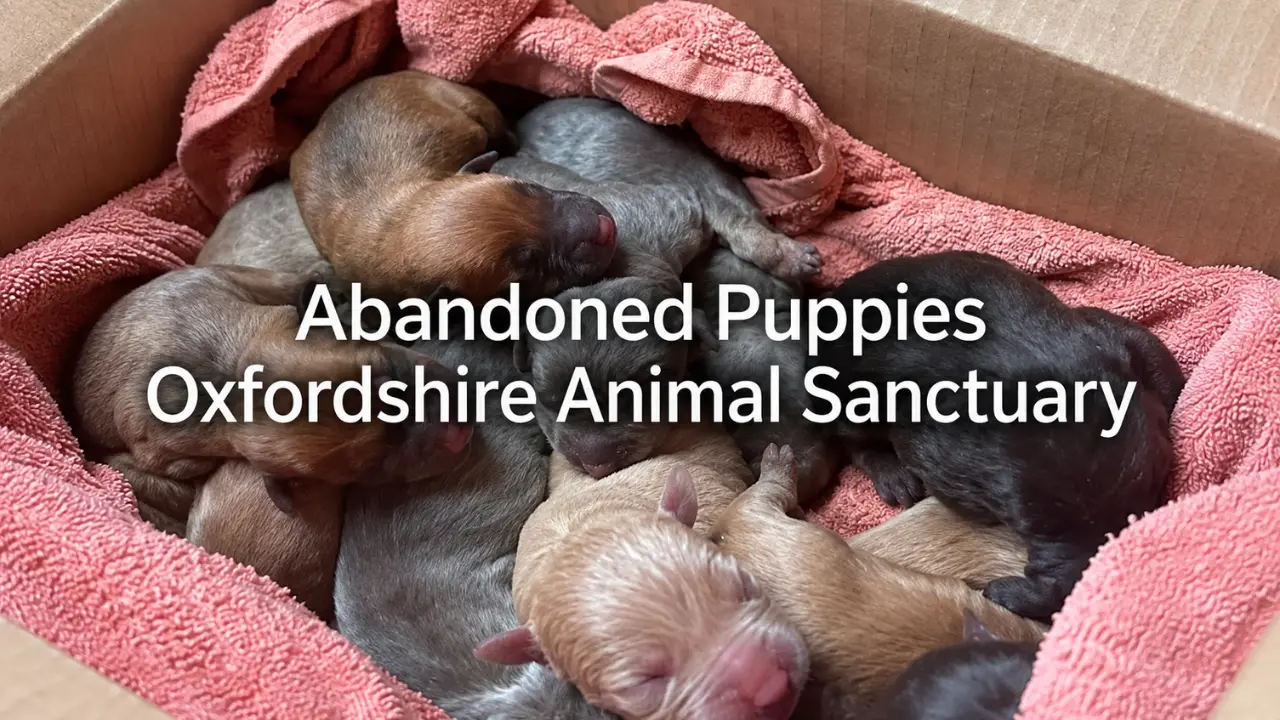
Seven puppies found abandoned under a bush in Abingdon, Oxfordshire, could easily have become another forgotten animal welfare case. Instead, a member of the public noticed them, got them to veterinary care and set in motion a rescue effort that eventually gave all seven a route toward new homes. The story of the abandoned puppies oxfordshire animal sanctuary is worth telling because it shows what responsible intervention actually looks like when animals are too young and vulnerable to survive without help.
The puppies were discovered on 28 March 2026 and taken to The Hart Veterinary Centre. They were described as being extremely cold and needing immediate attention and food. Once their condition was stabilised, Oxfordshire Animal Sanctuary became involved and arranged foster care while the puppies received the intensive attention they needed.
Seven puppies were discovered in Abingdon
The rescue began with an unsettling discovery.
Seven tiny puppies were found beneath a bush in Abingdon on 28 March. They were only around a month old, according to later reporting, and were still young enough to require milk and intensive care. A member of the public took them to The Hart Veterinary Centre rather than attempting to care for them without professional help.
That decision was crucial.
The puppies arrived cold and needed immediate attention. At such a young age, their condition could not simply be treated as a matter of finding somewhere warm for the night. They needed appropriate feeding, monitoring and veterinary assessment.
The abandoned puppies oxfordshire animal sanctuary story therefore began with an act that seems simple but can make all the difference in an animal rescue: someone saw animals in danger and took action.
The circumstances surrounding the abandonment were not established in the initial reports. There is no reason to fill that gap with speculation. What is known is enough to understand how serious the situation was.
Veterinary treatment came before rehoming
The first priority was keeping the puppies safe.
The Hart Veterinary Centre provided the initial emergency care after the puppies were brought in. Their body temperatures had to be stabilised before the next stage of their rescue could begin.
This is an important part of the abandoned puppies oxfordshire animal sanctuary story because animal rescue does not start with adoption photographs or new owners. It starts with getting vulnerable animals through the immediate crisis.
Very young puppies have demanding care needs. In this case, reports later stated that the puppies still needed their mother’s milk when they were found. They therefore required intensive bottle-feeding after entering charitable care.
That level of care requires time and commitment.
It also explains why simply leaving rescued puppies with a well-meaning member of the public would not necessarily have been enough. Their needs were too specific and their condition too fragile.
Oxfordshire Animal Sanctuary took over their care
Once the puppies had been stabilised, Oxfordshire Animal Sanctuary stepped in.
The sanctuary’s role was not limited to providing somewhere for the puppies to stay. It had to help organise the next stage of their recovery, including finding an appropriate foster home for animals that needed constant attention.
The abandoned puppies oxfordshire animal sanctuary case shows the importance of having a rescue organisation involved after an emergency veterinary visit. Medical treatment may solve the immediate problem, but young animals still need somewhere safe to recover.
Oxfordshire Animal Sanctuary says its work focuses on animals that have been mistreated, neglected, abandoned or can no longer be cared for by their owners. It currently cares for dogs, cats, rabbits and other animals and says its welfare decisions are based on the individual needs of each animal.
The sanctuary also says it has a strict no-destruction policy and does not euthanise healthy animals.
Foster care gave the puppies the attention they needed
Finding a foster home was one of the most important stages of the rescue.
The puppies were young, vulnerable and required round-the-clock monitoring. Oxfordshire Animal Sanctuary reported that a foster family was found to care for them after their veterinary checks.
Foster care can make a major difference for young animals because it gives them individual attention in an environment suited to their immediate needs.
For these puppies, that included intensive feeding. Later reporting stated that the charity’s team had to bottle-feed them because they still needed their mother’s milk when they were discovered.
The abandoned puppies oxfordshire animal sanctuary story is therefore also a story about the people behind rescue work. The puppies could not care for themselves, and their recovery depended on people being willing to take responsibility for the difficult daily tasks involved.
The puppies were initially identified differently from their later breed assessment
There is an important detail that should not be overlooked when reporting this rescue.
When the puppies were first taken into care, Oxfordshire Animal Sanctuary said they were believed to be Staffordshire Bull Terriers. At that stage, the breed was not certain.
Later reporting gave a different identification. After the puppies entered Blue Cross’s care, they were reported as Shih Tzus.
That change illustrates why early descriptions of rescued animals should be treated carefully. A puppy’s appearance can make an initial breed identification uncertain, particularly when the animals are very young.
For that reason, the most accurate way to describe the case is to say that they were initially believed to be Staffordshire Bull Terriers and were later identified as Shih Tzus.
The distinction matters because accuracy is more important than repeating the first description simply because it appeared in the earliest reports.
From emergency rescue to a new home
The seven puppies were eventually transferred to Blue Cross’s rehoming centre in Burford.
Later reports stated that the puppies were named Bernie, Tilly, Hettie, Betsy, Harold, Sandy and Norman. They subsequently found new homes.
That is the point where the story changes completely.
At the beginning, the puppies were seven vulnerable animals found alone outside. By the time they reached the rehoming stage, they had names, individual identities and people working to find suitable homes for them.
The abandoned puppies oxfordshire animal sanctuary journey shows why rehoming should be viewed as a process rather than a single event. Getting an animal out of immediate danger is only the beginning.
The ultimate goal is a stable home where the animal can remain safe and properly cared for.
Why responsible adoption matters after a rescue
A rescued puppy may inspire an immediate emotional reaction. That is understandable, but emotion alone should not determine an adoption decision.
Oxfordshire Animal Sanctuary’s adoption process is designed to assess whether an animal is suitable for a particular household. Potential adopters first review the animal’s profile and complete a pre-adoption questionnaire. If the application is suitable, the sanctuary contacts the applicant and arranges an appointment.
The sanctuary also says its dogs and cats undergo home checks and that animals receive appropriate veterinary assessment and care before adoption.
That approach is especially important with young dogs.
A puppy needs far more than food and affection. Its new owner needs to be prepared for training, veterinary care, exercise, routine and the changes that come as the animal grows.
A good rescue organisation should be willing to say no when a home is not suitable. That protects the animal and prevents the cycle of surrender and rehoming from repeating.
Oxfordshire Animal Sanctuary has a much wider role
The rescue of these seven puppies is only one part of the sanctuary’s work.
Oxfordshire Animal Sanctuary says it admits and rehomes around 700 animals each year. Its website currently reports that more than 35,000 animals have found forever homes since the sanctuary opened in 1967. It also says it can care for up to 30 dogs, around 60 cats and kittens and 15 to 20 rabbits at one time, alongside other animals.
That scale puts the abandoned puppies oxfordshire animal sanctuary story into perspective.
A rescue organisation is not dealing with one emergency at a time. While one group of puppies is being cared for, other dogs, cats and rabbits may also need veterinary treatment, behavioural support, accommodation or a permanent home.
The sanctuary says it is 100% donor funded and relies on public generosity to provide food and shelter.
That makes fundraising and donations an important part of the wider rescue system.
The sanctuary’s adoption process is deliberately careful
People interested in adopting from Oxfordshire Animal Sanctuary cannot simply turn up and take an animal home.
The sanctuary asks potential adopters to complete its pre-adoption questionnaire after reviewing an animal’s profile. It says applications are normally followed by contact within two to five working days when everything is in order, after which an appointment can be arranged.
Visits are arranged only after an application has been submitted.
Before adoption, animals receive appropriate veterinary checks. The sanctuary states that its dogs are neutered and vaccinated, and dogs are also microchipped and checked by its vet.
This is not bureaucracy for its own sake.
It is a way of making sure that the excitement of adopting an animal does not overshadow the practical responsibilities that come with ownership.
People can help without adopting a dog
Adoption is not the only way to support an animal rescue organisation.
Oxfordshire Animal Sanctuary offers fostering opportunities and also lists dog walking, fundraising, sponsorships and donations among the ways people can become involved.
Fostering is particularly important because some animals need a temporary home before they are ready for adoption. The sanctuary specifically asks whether people can provide temporary homes for animals preparing for adoption.
The abandoned puppies oxfordshire animal sanctuary case makes the value of foster care obvious. Without a suitable foster arrangement, very young animals requiring intensive attention can be much harder to accommodate.
Not everyone can foster or adopt. That does not mean they cannot contribute.
Donations help cover the ordinary costs that are easy to overlook: food, shelter, veterinary treatment and daily care.
What this rescue says about abandoned animals
The most uncomfortable part of the story is also the simplest.
Seven puppies should not have been left in a situation where strangers had to discover them and organise their rescue.
Their recovery was possible because people intervened quickly. But animal charities cannot prevent every abandonment case, and rescue centres operate with finite resources.
Oxfordshire Animal Sanctuary itself says it maintains a waiting list when it reaches full capacity and may direct owners toward other organisations or alternative resources when it cannot safely admit an animal.
That reality deserves more attention.
Animal rescue is not an unlimited safety net. Every organisation has physical space, staff, foster carers and funding limits. Preventing abandonment through responsible ownership, neutering, vaccination, microchipping, education and early support can reduce the pressure on the rescue system.
The sanctuary specifically identifies education and responsible pet ownership as part of its mission.
The seven puppies were lucky that someone stopped
The abandoned puppies oxfordshire animal sanctuary story ends positively because the chain of care held together.
Someone found the puppies.
A veterinary team treated them.
Oxfordshire Animal Sanctuary took responsibility for their care.
A foster family provided the attention they needed.
Blue Cross later helped with their rehoming.
And the puppies eventually found new homes.
That outcome should be celebrated, but it should also make people think.
The best rescue story is not one where animals are repeatedly saved after being abandoned. The best outcome is preventing animals from reaching that point at all.
For these seven puppies, a second chance was possible because somebody chose to act instead of walking past. That is the lesson worth keeping: when an animal is helpless, responsibility belongs to the people who are in a position to help. And when it comes to pet ownership, the strongest act of compassion is making sure an animal never has to depend on a rescue story for its future.
FAQs
1. How old were the puppies when they were found?
Later reporting stated that the puppies were about one month old when they were discovered. They were still young enough to need their mother’s milk, which is why intensive bottle-feeding became part of their care.
2. Were the puppies definitely Staffordshire Bull Terriers?
No. Their breed was initially believed to be Staffordshire Bull Terrier, but that identification was not certain. Later reporting after they entered Blue Cross’s care identified them as Shih Tzus.
3. What were the rescued puppies called?
The seven puppies were later named Bernie, Tilly, Hettie, Betsy, Harold, Sandy and Norman. Reports subsequently stated that they found new homes.
4. Does Oxfordshire Animal Sanctuary accept every animal brought to it?
No. The sanctuary says admissions depend on whether it has capacity and can meet the animal’s needs. When it is full, it may maintain a waiting list or direct people toward other organisations and resources.
5. What should someone do if they discover abandoned puppies?
The safest response is to get appropriate professional help quickly rather than trying to manage vulnerable puppies alone. In this case, the person who found the puppies took them to a veterinary centre, where they could receive immediate assessment and care.