
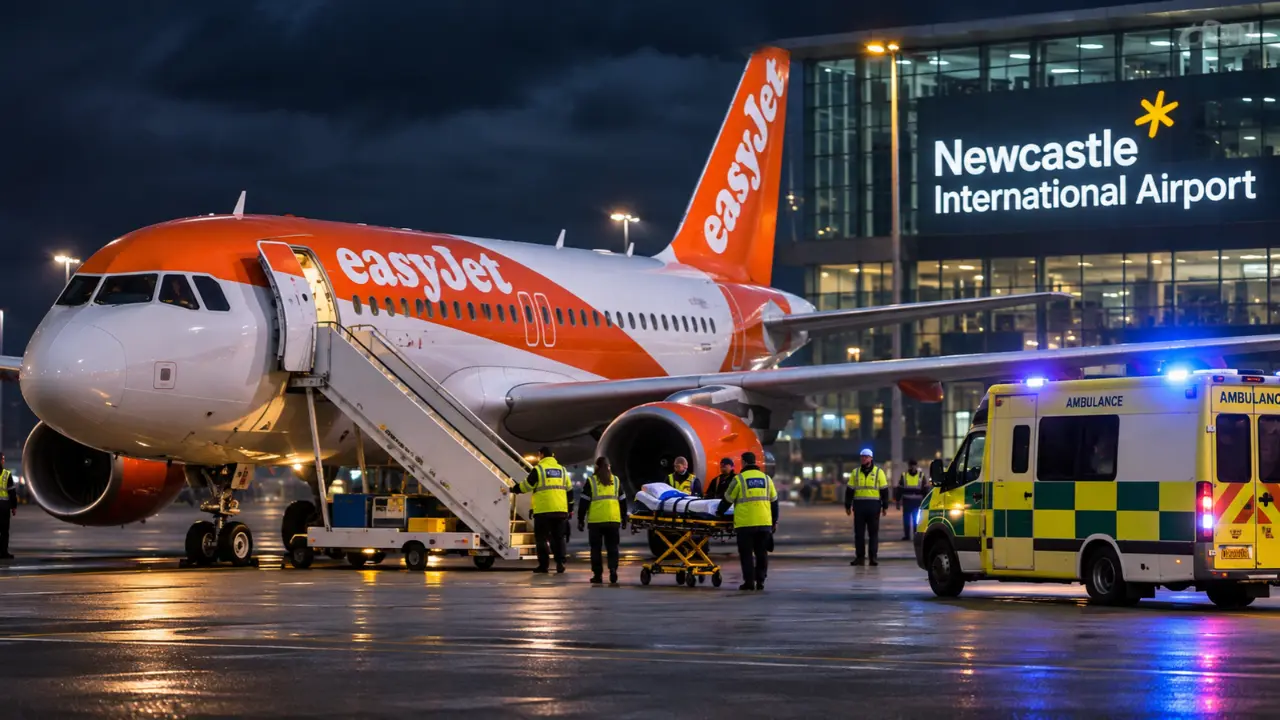
The easyjet flight u2238 emergency landing newcastle story sounds more dramatic than the facts actually were. An easyJet aircraft travelling from Copenhagen to Manchester diverted to Newcastle on the night of October 27, 2025, after a passenger required urgent medical attention. The aircraft landed safely, medical personnel attended the passenger, and the flight later continued to Manchester. There was no reported crash, fire or confirmed aircraft failure behind the diversion.
There is also an important flight-number detail that has caused confusion online. Contemporary reports identify the aircraft as easyJet U2 2238, written without the space as U22238 and also shown as EZY2238. The commonly searched phrase “easyjet flight u2238 emergency landing newcastle” drops one of the repeated digits. The distinction matters because flight numbers identify specific services, and U22238 is the service that operated between Copenhagen and Manchester. Current flight schedules also identify U2 2238 as the Copenhagen-Manchester route.
What Happened to the easyJet Flight?
The flight departed Copenhagen Airport in Denmark on Monday, October 27, 2025, bound for Manchester Airport in England. According to contemporary aviation reporting, the aircraft was an Airbus A320-214 registered G-EZPB. It was cruising at approximately 38,000 feet over the North Sea when the crew declared an emergency after a passenger welfare issue developed onboard.
Instead of continuing west toward Manchester, the pilots diverted toward Newcastle International Airport.
That was a sensible decision. Newcastle provided an airport where the aircraft could land quickly and where medical assistance could meet the passenger on arrival. This is one of the key facts that should not get lost when discussing the easyjet flight u2238 emergency landing newcastle incident: the diversion was driven by the needs of a passenger, not by evidence of a catastrophic aircraft problem.
The aircraft landed at Newcastle at approximately 22:52 GMT on runway 25. Medical personnel then attended the passenger. After the situation had been dealt with, the aircraft eventually resumed its journey to Manchester.
Why Did the Plane Divert to Newcastle?
The reported reason was a passenger welfare issue requiring urgent medical attention.
easyJet subsequently confirmed that flight EZY2238 from Copenhagen to Manchester had diverted to Newcastle because a customer onboard needed urgent medical attention. The airline said medical services met the passenger after the aircraft arrived and that the flight later continued to Manchester.
That explanation is much more useful than speculation about an engine failure or mechanical breakdown.
When an airline crew decides that a passenger needs urgent medical care, continuing to the originally planned destination may not be the best option. A diversion allows the crew to reach an airport where emergency services can respond immediately.
The easyjet flight u2238 emergency landing newcastle incident therefore illustrates a relatively straightforward aviation principle: an emergency diversion does not automatically mean that the aircraft itself is in danger of crashing.
The crew still has to treat the situation seriously. In this case, the aircraft transmitted the emergency transponder code 7700 while diverting. That code alerts air traffic control that an aircraft is experiencing an emergency and requires priority handling.
What Does Squawk 7700 Tell Us?
The appearance of 7700 in flight-tracking information is one reason the incident attracted attention.
Squawk 7700 is the internationally recognised transponder code used to indicate a general emergency. It does not tell the public exactly what the emergency is. The code could accompany a medical situation, technical problem, fire or another serious event requiring priority assistance.
In this case, available reporting links the emergency declaration to the passenger welfare situation.
That distinction is worth making because a flight tracker showing 7700 can look alarming without explaining what is happening inside the cabin. The code tells air traffic control that the crew needs emergency handling. It does not, by itself, identify the cause.
For readers following the easyjet flight u2238 emergency landing newcastle story through flight-tracking websites, that is an important piece of context.
What Aircraft Was Involved?
The aircraft was an Airbus A320-214 with registration G-EZPB, according to contemporary aviation reporting. The aircraft was operating an easyJet service between Copenhagen and Manchester when the diversion occurred.
There is no reliable contemporary evidence showing that the aircraft suffered an engine failure, fire, cabin-pressure failure or structural problem during the flight.
That point should be kept separate from the fact that the crew declared an emergency.
An aircraft can declare an emergency because of a person onboard. The emergency declaration is about the seriousness of the situation and the need for priority assistance, not necessarily about the condition of the aircraft itself.
The fact that the aircraft later continued to Manchester is also consistent with the reporting that the diversion was caused by the passenger’s medical situation rather than an aircraft failure.
What Happened When the Aircraft Reached Newcastle?
The aircraft landed safely at Newcastle International Airport shortly before 11 p.m. GMT.
Medical personnel were available to deal with the passenger who needed assistance. The aircraft was then able to continue its journey instead of remaining at Newcastle indefinitely.
For passengers onboard, the unexpected stop would obviously have changed the night. They had expected to fly directly from Copenhagen to Manchester, but instead found themselves landing in Newcastle because of an urgent situation involving another passenger.
Still, the sequence of events is significant. The aircraft did not make an uncontrolled or crash landing. It diverted, landed at a suitable airport, received the necessary ground response and then continued.
That is a very different scenario from the dramatic picture that the phrase easyjet flight u2238 emergency landing newcastle might initially create.
Did the Flight Eventually Reach Manchester?
Yes.
After the Newcastle diversion, the aircraft resumed its journey and landed at Manchester at approximately 00:28 GMT on October 28. AIRLIVE’s flight-tracking report says the aircraft resumed the flight roughly an hour after arriving at Newcastle and spent about 26 minutes in the air before reaching Manchester.
The unexpected stop naturally made the journey longer than planned, but the aircraft did eventually complete its original route.
This is one of the clearest facts separating the incident from an aircraft accident. The aircraft remained operational after the Newcastle stop and continued to its scheduled destination.
Why Are People Searching for “U2238” Instead of “U22238”?
The flight-number confusion deserves attention because it can easily lead readers to the wrong flight.
easyJet uses U2 as its IATA airline code. The Copenhagen-Manchester service had the flight number 2238. Written together, that becomes U22238.
The same flight can also appear as EZY2238 because EZY is easyJet’s ICAO airline designator. Flight information services can therefore display U22238 and EZY2238 for the same service.
That is why the phrase easyjet flight u2238 emergency landing newcastle appears alongside reports referring to U22238 or EZY2238.
The distinction is not just a technicality. Removing one digit can point readers toward another flight number entirely. Current flight data identifies U2 2238 as the Copenhagen-Manchester service, while the shorter U2238 designation can be associated with a different easyJet flight number.
For an article covering the incident, the safest approach is to acknowledge the search phrase while identifying the actual service as U2 2238/U22238/EZY2238.
Was There an Aircraft Mechanical Failure?
There is no reliable evidence in the contemporary reporting that a major mechanical failure caused this particular diversion.
The reported cause was a passenger welfare issue. easyJet said the customer required urgent medical attention, and medical services met the passenger after the aircraft arrived in Newcastle.
That makes claims about an engine problem, fire or structural failure difficult to support.
Aviation stories can change quickly online because an emergency transponder code is visible to anyone following a flight tracker. People see a plane change direction, see 7700 appear and naturally assume the aircraft itself has suffered a serious malfunction. But the later information matters more than the initial appearance on a tracking map.
In the easyjet flight u2238 emergency landing newcastle case, the available evidence points to a medical diversion.
What Information About the Passenger Is Public?
Public reports confirm that a passenger required urgent medical attention. They do not provide enough reliable information to establish the person’s medical diagnosis, identity or later condition.
That is where an article should stop.
There is no reason to turn an aviation report into speculation about a private passenger’s health. Unless the airline, emergency services or another authoritative source publicly confirms additional information, claims about the passenger’s condition should not be presented as fact.
The confirmed sequence is enough: a passenger became unwell, the crew declared an emergency, the aircraft diverted to Newcastle, medical personnel attended after landing, and the flight later continued to Manchester.
What the Newcastle Diversion Says About Flight Emergencies
The incident is a useful reminder that “emergency landing” covers a wider set of situations than many people realise.
Airliners are designed to divert when continuing the original route is no longer the safest or most practical option. The nearest suitable airport is not necessarily the airport that looks closest on a map. Crew members and air traffic controllers consider runway availability, weather, airport facilities, aircraft condition, fuel, operational requirements and the nature of the emergency.
For a passenger requiring urgent medical treatment, an airport with appropriate medical access can become the logical destination.
In this case, Newcastle became that destination.
The crew did not simply abandon the planned journey. They changed the plan because the situation onboard demanded it, landed safely and then continued once the immediate problem had been handled.
That is the central fact behind the easyjet flight u2238 emergency landing newcastle report.
The Timeline of the Incident
The key sequence is relatively clear.
The easyJet aircraft departed Copenhagen on the evening of October 27, 2025, heading for Manchester. It was operating later than its scheduled departure time. During the flight over the North Sea, a passenger welfare situation became serious enough for the crew to declare an emergency.
The aircraft then changed course for Newcastle International Airport rather than continuing to Manchester.
It landed on runway 25 at approximately 22:52 GMT. Medical personnel attended the affected passenger after arrival.
The aircraft subsequently departed Newcastle and continued toward Manchester.
It reached Manchester at approximately 00:28 GMT on October 28.
That timeline gives readers a much clearer picture than a headline suggesting an unexplained emergency landing.
What Travelers Should Take From the Incident
The biggest lesson is simple: an emergency diversion is not automatically a sign that an aircraft is about to crash.
Passengers should still take crew instructions seriously, but they should also understand why pilots may suddenly change destination. A medical emergency can require immediate access to ground-based medical care, and diverting to a suitable airport can be the safest decision available.
The easyjet flight u2238 emergency landing newcastle incident ended with the aircraft continuing to Manchester. That outcome does not make the passenger’s situation insignificant. It shows that the crew responded to an urgent problem, used the available airport network and allowed medical professionals to take over once the aircraft was safely on the ground.
For people searching easyjet flight u2238 emergency landing newcastle because they saw the story on social media or a flight tracker, the facts are less sensational but more informative: this was a medical diversion involving the Copenhagen-Manchester service, not a reported crash.
The Flight Number Matters More Than It Looks
The online confusion surrounding this event is almost as interesting as the diversion itself.
Searches for easyjet flight u2238 emergency landing newcastle can lead readers toward reports using U2238, U22238 and EZY2238. Those identifiers should not simply be treated as interchangeable without explanation.
The service involved was easyJet U2 2238, commonly written as U22238, with EZY2238 used as the corresponding ICAO identifier. Flight schedule data continues to identify U2 2238 as the Copenhagen-Manchester route.
Getting that detail right is important because aviation reporting depends heavily on accurate flight identification. A single missing digit can send readers looking at a completely different service.
The easyjet flight u2238 emergency landing newcastle story is therefore best understood through the corrected flight identification, the confirmed medical reason for the diversion and the actual sequence of events at Newcastle.
The bottom line is straightforward. An easyJet flight from Copenhagen to Manchester diverted to Newcastle on October 27, 2025, because a passenger required urgent medical attention. The aircraft landed safely, medical services attended the passenger and the plane later continued to Manchester. There is no solid evidence that an aircraft malfunction caused the diversion.
The headline may sound alarming, but the facts tell a more precise story: the crew faced an urgent passenger situation, made a diversion decision, landed safely and completed the journey. That is the detail worth remembering when the easyjet flight u2238 emergency landing newcastle phrase appears online.
Frequently Asked Questions
Was the easyJet aircraft damaged during the Newcastle diversion?
There is no reliable report indicating that the aircraft was damaged during the diversion. The Airbus A320 landed safely and later continued to Manchester.
Was Newcastle the flight’s original destination?
No. The aircraft was scheduled to fly from Copenhagen to Manchester. Newcastle became the diversion airport because of the passenger welfare emergency.
Why did the pilots use emergency code 7700?
The crew used squawk 7700 to signal an emergency to air traffic control. The code provides priority handling but does not itself identify the exact cause of the emergency.
Was the passenger’s medical condition publicly confirmed?
Only the need for urgent medical attention was confirmed in reliable reporting. The passenger’s specific diagnosis and later medical condition were not reliably disclosed.
Why do reports use both U22238 and EZY2238?
They identify the same easyJet service using different airline flight-number conventions. The service is U2 2238/U22238 commercially and is also identified as EZY2238 in aviation systems.