
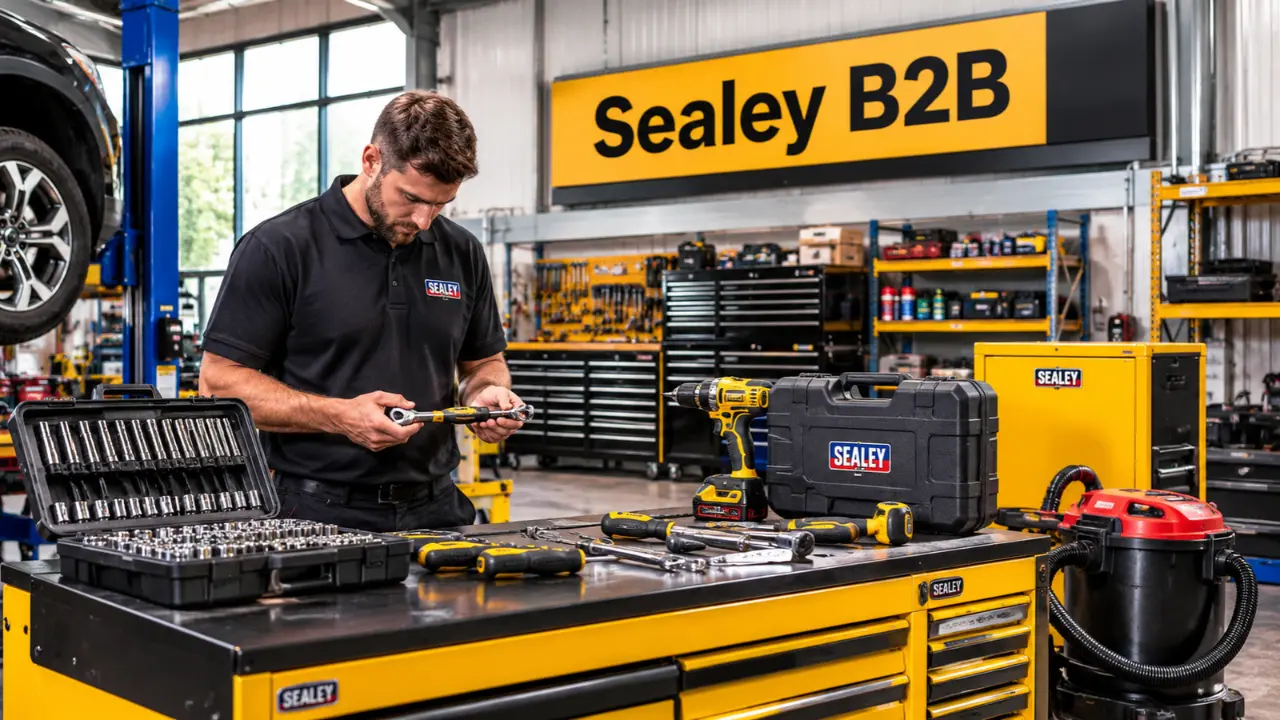
For businesses that depend on reliable tools and workshop equipment, choosing the right supplier is about much more than comparing prices. Product availability, ordering convenience, technical assistance, and dependable aftersales support all influence how efficiently a business can operate. Sealey B2B brings these considerations together through a trade-focused platform backed by the established product range and distribution network of SEALEY. Its approach is particularly relevant to independent retailers, automotive equipment dealers, engineering suppliers, and professional stockists that need access to a broad selection of tools without managing relationships with multiple manufacturers.
What makes the platform worth examining is the connection between its online ordering facilities and the wider services provided by the company. From trade pricing and account information to product documentation and spare-parts assistance, the system is designed around the practical requirements of businesses that sell or use professional equipment. Understanding how these services work helps potential customers assess whether the platform fits their purchasing arrangements and day-to-day operations.
The Company Behind the Sealey B2B Platform
SEALEY has operated in the professional tools and equipment market since 1978. The company, known as Jack Sealey Limited, has developed a substantial presence in the United Kingdom and international markets through its range of workshop products, tools, and equipment.
Its business is built around supplying products to professional users and trade customers through an established dealer and stockist network. This approach allows independent businesses to serve their own customers while sourcing equipment from a recognised supplier.
The company’s product catalogue covers several industries, including automotive maintenance, engineering, agriculture, construction, and general workshop operations. Its range extends beyond basic hand tools to include specialist machinery, lifting equipment, electrical products, and workshop accessories.
SEALEY reports a catalogue containing more than 13,000 product lines, with its 2025/26 catalogue highlighting over 1,500 new additions. That breadth matters to trade businesses because customers rarely need just one type of equipment. A garage might purchase diagnostic equipment, lifting accessories, hand tools, and power tools within the same ordering cycle.
Sealey B2B supports this wider commercial operation by giving registered trade customers a dedicated environment for managing their purchasing activities.
How Sealey B2B Supports Trade Purchasing
Traditional wholesale purchasing can involve repeated communication with sales representatives, checking product availability, requesting prices, and following up on orders. These activities are manageable for occasional purchases but become time-consuming when a business regularly replenishes stock.
The Sealey B2B platform provides registered customers with an online ordering facility intended to reduce some of this administrative work.
Its 24-hour ordering access is particularly useful for businesses that operate outside conventional office schedules. A workshop manager might identify a shortage during an afternoon inspection, while a retailer may review stock requirements after closing time. Online access allows purchasing activities to take place without relying entirely on telephone support.
The platform also provides access to trade-related account information. Customers can review relevant details such as previous orders, account balances, and credit limits, depending on their account permissions.
This matters because purchasing decisions often depend on more than the price of an individual product. A business needs to understand its available account facilities, previous buying activity, and current requirements before placing another order.
Sealey B2B brings these activities into a single business-facing environment, making routine purchasing easier to manage.
Trade Pricing and Account Management for Registered Customers
Pricing is one of the most important considerations for any retailer or equipment distributor. Businesses need to understand their purchasing costs before deciding how to price products for their own customers.
Sealey B2B provides registered trade customers with access to applicable trade pricing. This gives businesses a clearer view of their purchasing arrangements when evaluating products and planning orders.
However, trade pricing should not be confused with a universal discount available to every visitor. Actual prices and account conditions can depend on customer registration, commercial arrangements, and applicable account terms.
Account management is another important part of the platform. Businesses can access information relevant to their purchasing relationship, including order history and account details. Having this information available online can reduce the need to maintain separate records for every transaction.
The multiple-user facility is also worth attention. Businesses with purchasing teams can benefit from allowing different authorised employees to access the platform. For example, a workshop supervisor might identify equipment requirements, while an office administrator handles the actual ordering process.
This division of responsibility can make purchasing easier to organise, particularly when several people contribute to stock management.
For companies considering Sealey B2B, understanding account permissions and available purchasing facilities should be part of the registration process.
Product Range: From Everyday Hand Tools to Specialist Equipment
A trade platform becomes more useful when its product selection matches the actual requirements of its customers. SEALEY’s extensive catalogue is one of the strongest aspects of its business offering.
The company supplies equipment across several categories, allowing retailers and professional buyers to source products for different applications.
Hand tools and workshop essentials
Hand tools remain essential in automotive garages, maintenance departments, engineering workshops, and general repair businesses. SEALEY offers products such as socket sets, spanners, screwdrivers, pliers, and other equipment used for routine mechanical work.
These products are relevant to retailers because they serve a broad customer base. Professional mechanics may require specialist sets, while general maintenance businesses often need dependable everyday equipment.
Automotive and garage equipment
Automotive equipment represents an important part of the company’s catalogue. Vehicle servicing businesses need equipment that supports inspection, repair, maintenance, and workshop operations.
Garage equipment can include lifting products, workshop tools, electrical equipment, and accessories used by professional mechanics.
For automotive retailers, having access to several related product categories through one supplier can simplify stock planning.
Power tools and electrical equipment
Power tools support tasks that would otherwise require considerable manual effort. They are used in workshops, construction environments, engineering facilities, and maintenance operations.
SEALEY’s range includes professional power tools and related accessories designed for different working requirements.
Lifting and handling equipment
Vehicle workshops and industrial facilities often need specialised equipment for lifting and handling heavy items. Appropriate lifting products can support routine maintenance and workshop operations when selected and used according to their specifications.
Agricultural and engineering products
Agricultural businesses require equipment for machinery maintenance, repairs, and general workshop activities. Engineering customers have different requirements, including tools and machinery for technical applications.
The breadth of the SEALEY catalogue gives trade customers access to products serving these distinct markets without limiting their purchasing to one narrow category.
Why Product Availability Matters More Than Catalogue Size
A large product catalogue is useful, but it does not automatically guarantee a successful purchasing experience.
For a retailer, an unavailable product can mean a delayed customer order. For a garage, a missing piece of equipment may interrupt a planned maintenance job. The commercial impact depends on how urgently the item is needed and whether a suitable alternative exists.
This is why stock information is an important feature of Sealey B2B.
Access to availability information helps registered customers make more informed decisions before submitting orders. Rather than treating every listed product as immediately available, buyers can consider stock status when deciding what to purchase.
Businesses should still check the details displayed during ordering and confirm any important delivery arrangements through the appropriate customer support channel.
Stock planning also requires a degree of discipline. Retailers should identify frequently purchased items, monitor replenishment requirements, and avoid relying entirely on last-minute orders.
A supplier’s online system can support these activities, but accurate internal stock records remain the responsibility of the business.
The Role of SEALEY’s Dealer and Stockist Network
SEALEY’s dealer and stockist network is central to its commercial approach. Rather than relying exclusively on direct consumer sales, the company works with trade businesses that distribute products to their own markets.
This arrangement benefits independent retailers because they can offer equipment from an established manufacturer without developing their own product ranges.
For customers, local stockists can provide a point of contact for product enquiries, purchasing assistance, and equipment selection.
A retailer specialising in automotive supplies, for example, may use the SEALEY range to serve mechanics, independent garages, and vehicle maintenance businesses. An engineering supplier may focus on machinery, workshop equipment, and technical tools.
The requirements of these businesses are different, but both can benefit from access to an established supplier’s catalogue.
Sealey B2B supports this relationship by providing trade customers with online purchasing and account facilities. It complements the dealer network rather than replacing the value of direct customer relationships.
Businesses interested in joining the network should check the company’s current stockist requirements and registration arrangements. Access to the trade platform should not be assumed to be available to every general consumer.
Customer Support, Repairs and Spare Parts
Equipment purchases do not end when a product is delivered. Professional users also need access to technical information, repair services, replacement parts, and warranty assistance.
This is an important consideration when evaluating any tools supplier.
SEALEY provides aftersales services that include technical support, repair facilities, spare-parts assistance, and product warranty procedures. The company also highlights a substantial spare-parts inventory, reporting more than 165,000 individual parts.
For a workshop, the availability of replacement components can influence how long equipment remains useful. A repairable product may be a more practical investment than one that must be replaced whenever a particular component fails.
The company also states that its service centre aims to process repairs within 48 hours of receiving a product. This is a stated service target rather than a guarantee that every repair will be completed within that period.
Customers should check the applicable warranty conditions, repair requirements, and service arrangements for their particular product.
Sealey B2B makes the purchasing side of the relationship more accessible, while the wider company support structure addresses requirements that arise after a sale.
How Multiple User Accounts Can Help Growing Businesses
Businesses with several employees often need a clear purchasing process. Allowing every employee to place orders without coordination can lead to duplicate purchases, unnecessary spending, and confusion over account responsibilities.
The multiple-user facility associated with Sealey B2B can help registered businesses organise access among authorised team members.
Consider an independent equipment retailer with a store manager, purchasing administrator, and warehouse supervisor. Each employee may have a different role in the purchasing process.
The warehouse supervisor identifies products that need replenishment. The manager reviews the requirements, while the purchasing administrator handles the order.
A shared business platform can help these employees work from the same account environment rather than relying on disconnected communication.
The precise permissions available to individual users should be confirmed with SEALEY, as account access arrangements may vary.
For larger businesses, establishing internal purchasing rules remains essential. Online access improves convenience, but it does not replace approval procedures or spending controls.
International Distribution and Market Reach
SEALEY has expanded its commercial presence beyond the United Kingdom. The company reports supplying products to more than 70 countries through its international distribution arrangements.
This international reach is relevant because professional tools and workshop equipment serve industries with similar operational requirements across different markets.
An automotive equipment retailer in one country may need many of the same product categories as a supplier operating in another. Engineering workshops, agricultural businesses, and industrial maintenance teams also require specialised equipment regardless of their location.
However, international availability does not mean every product can be ordered under identical conditions in every market.
Local distributors, import arrangements, shipping costs, taxes, warranty coverage, and regional product availability can all affect purchasing decisions.
Businesses outside the UK should therefore check their local SEALEY distributor or authorised stockist for information about ordering, delivery, and aftersales assistance.
The international network gives the brand a wider market presence, but local commercial arrangements remain important.
What Businesses Should Consider Before Using Sealey B2B
Although the platform provides useful trade facilities, businesses should evaluate their requirements before making it part of their regular purchasing process.
The first consideration is eligibility. Since the system is designed for trade customers, potential users should establish whether their business qualifies for registration and what information is required.
Pricing is another important factor. Buyers should review their applicable trade prices and commercial conditions rather than assuming every product offers the same margin or purchasing advantage.
Delivery arrangements also deserve attention. Product availability, order processing, shipping charges, and delivery times can influence the final cost of purchasing equipment.
Businesses should also examine aftersales arrangements. Warranty coverage, spare-parts access, repair procedures, and technical assistance can become particularly important when buying expensive workshop machinery.
Finally, companies should consider whether the product range matches their customer base. A specialist automotive retailer may find the catalogue particularly relevant, while a business focused on an unrelated product category may have fewer reasons to use the platform.
The strongest purchasing decisions come from matching supplier capabilities with actual business requirements.
Frequently Asked Questions About Sealey B2B
1. Can an individual customer register for a Sealey B2B account?
The platform is intended for registered trade customers and stockists rather than ordinary consumer shopping. Individuals should contact SEALEY to establish whether their business circumstances meet the current registration requirements.
2. Can businesses check previous purchases through the platform?
Yes. Account facilities include access to order history, allowing registered customers to review previous purchasing activity and use that information when planning future orders.
3. Does SEALEY provide replacement parts for discontinued or older equipment?
SEALEY maintains a substantial spare-parts inventory and provides parts assistance. However, availability depends on the specific product, component, and current stock situation. Customers should provide the relevant model or product details when making an enquiry.
4. Can a business allow multiple employees to access its trade account?
The platform supports multiple-user accounts. This can help businesses distribute purchasing responsibilities among authorised employees. Specific access permissions should be confirmed during account setup.
5. Does buying through Sealey B2B automatically include free delivery?
Free delivery should not be assumed for every order. Delivery charges and conditions can depend on the account arrangement, order value, destination, and applicable commercial terms. Businesses should review the current conditions before confirming purchases.
Conclusion
A trade supplier earns its place in a business’s purchasing process through consistent product access, practical account facilities, and support that continues after delivery. SEALEY has built its commercial offering around these requirements, combining an extensive tools catalogue with a dealer network and dedicated aftersales services.
Sealey B2B is particularly relevant to retailers, workshop suppliers, and professional stockists that want a more organised way to manage trade purchasing. Its online ordering facilities, account information, product availability details, and multiple-user access address real administrative needs.
Still, a large catalogue alone should never determine a supplier relationship. Businesses should examine actual pricing, stock conditions, delivery arrangements, and repair support before committing to regular orders.
The real value lies in how well the platform supports a company’s day-to-day purchasing decisions. For trade businesses whose product requirements match SEALEY’s range, that practical value is the strongest reason to consider making it part of their supply arrangements.